Can I use AI models for my clothing brand?
Last checked Oct 21, 2026 · Reviewed by Museify team · 8 min read
Yes, you can, as long as the garment is your own and you are open about it. AI model photos are good for testing a new style or colour of your bestseller in ads before you make it. They can’t prove how the garment fits, drapes or feels, so treat them as concept images and swap them for real photos once the product exists. Use our own AI models, never a real person’s face or another brand’s photos. Expect ad platforms to label AI images, keep the AI tag in your image files for Google Shopping [4], and tell buyers plainly on the product page. This guide is our summary, not legal advice; each platform decides what it accepts.
What AI model photos are good for, and what they can’t prove
The honest use of an AI model is to answer one question early: would people click on this version of your garment? You can show a new colour, pattern or detail on a body before you pay for samples, then put the money behind the version that wins.
| Good for | Can’t prove |
|---|---|
| Showing a new colour, pattern or detail of your bestseller before it exists | How the finished garment fits a real body |
| A fair ad test: same model, same pose, same light, only one thing changed | How the fabric drapes, stretches or moves |
| Ad sizes for feeds and stories without a photoshoot | True colour, texture and weight once a factory makes it |
| Deciding which version to sample first | That a size runs true; only real samples and measurements can say that |
Buyers notice the gap. In 2025 an Australian label that used AI imagery instead of real models said so on the listing, and shoppers on Reddit still called it deceptive, mainly because a pricey dress could only be seen as an AI image and they couldn’t tell how it would fit or move [8]. Sellers report the same mood in streetwear communities. The lesson isn’t “never use AI”; it’s that AI photos work for testing interest, and real photos have to take over once you sell the finished garment.
Use your own garment, never someone else’s photo or face
- Start from your own product: a photo of your bestseller on a model, flat, on a mannequin or on a hanger.
- Don’t edit the real person in your photo. If your original shot has a model in it, the new images should use an AI model, not a changed version of that person.
- Don’t make an AI model that looks like a real person: an influencer, a celebrity, a competitor’s model or a friend. Rules on using someone’s likeness differ by country, and it is a trust problem everywhere.
- Don’t start from another brand’s product photos. Borrowing a mood is one thing; copying their garment or shoot is another.
Under the EU AI Act, people who use AI professionally must disclose a deepfake, which the Commission describes as AI content that resembles existing people, objects or places and could falsely appear real [5]. Whether a concept image counts depends on context, such as who the person looks like and how the image is presented [5]. Using an obviously generic AI model and saying the images are AI-made keeps you well away from that line.
Show more than one body
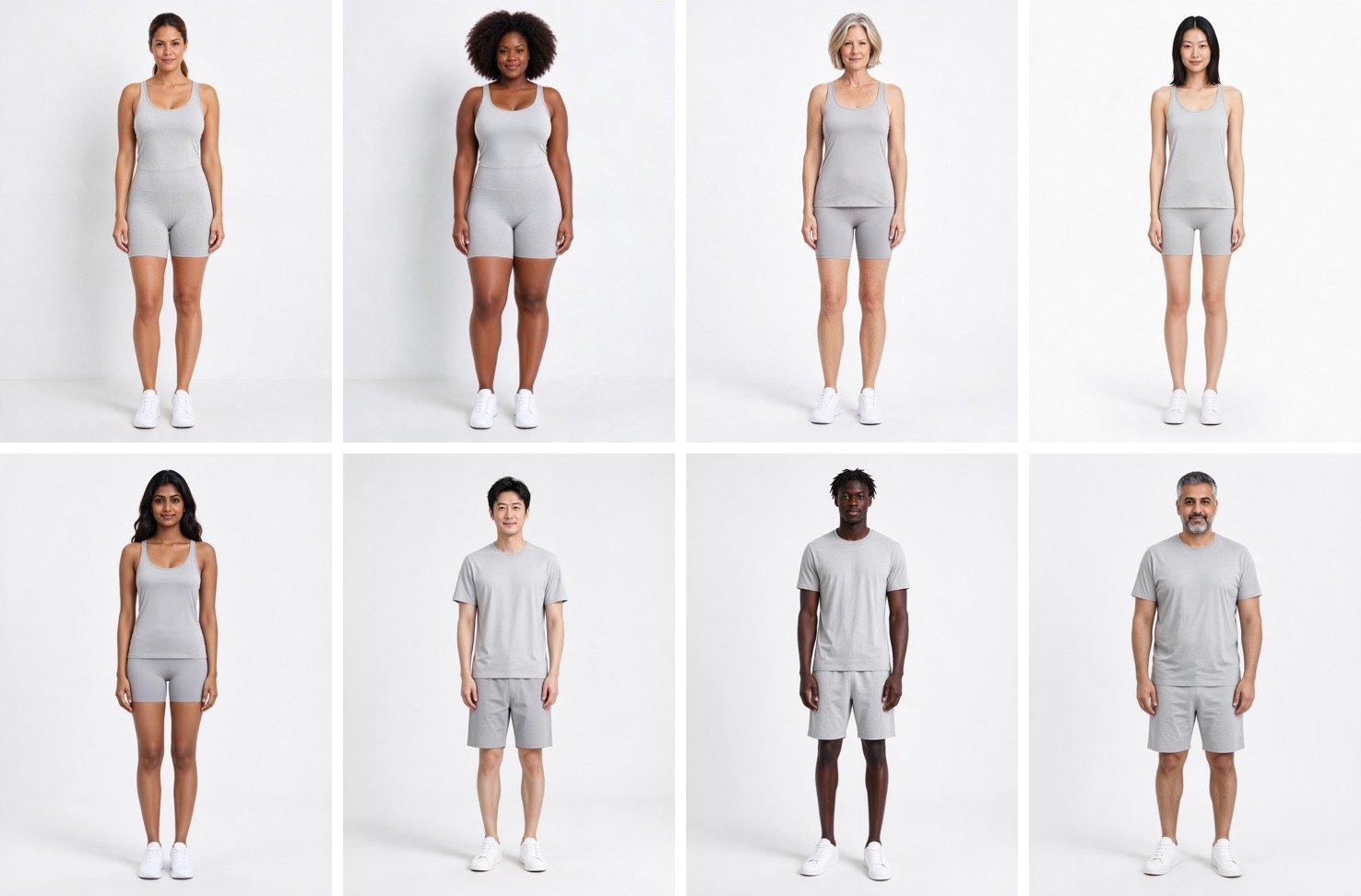
If every test image shows the same slim, young model, you learn less and you lose the buyers who don’t see themselves in your ads. Pick models across skin tones, ages and body types that match who buys your bestseller.
Be specific about the body. In our own tests, image models tended to draw people slimmer than asked, so a request for “curvy” on its own often comes back as a standard sample size. Describe the size and build you mean, for example a UK 18 or US 14 with a fuller bust and hips, and check the result before you use it.
Keep one model for the whole test. If version B is on a different person from version A, you can’t tell whether the garment or the model won the click.
When ads and shopping feeds label AI images
Expect your AI model photos to be labelled in ads, and plan for it rather than trying to avoid it. A short version of the main rules, as we read them on 21 October 2026:
- Meta (Facebook and Instagram): ads made or significantly edited with Meta’s own AI tools, or with third-party AI tools, may get an “AI info” label; small edits such as resizing or colour correction don’t [2]. In June 2026 Meta said it would start detecting ads made with third-party tools through industry-standard signals and show the label in “About this ad” [1]. Its original 2025 announcement said that when Meta’s own tools add a photorealistic AI person, the label shows next to Sponsored [1], and the help page says it sometimes appears there [2]. Meta also says the experience may vary by region [1].
- TikTok: for a regular ad (not a Spark Ad) whose image, video or audio is completely AI-generated or significantly modified by AI, you tick “This ad contains AI-generated content” when you create the ad [3]. Spark Ads follow TikTok’s Community Guidelines for AI content instead [3].
- Google Merchant Center: product images made with generative AI must carry IPTC DigitalSourceType metadata set to trainedAlgorithmicMedia, and Google asks you not to remove it [4]. AI-written titles and descriptions go in structured_title and structured_description [4].
- EU: the AI Act’s transparency rules in Article 50 apply from 2 August 2026, covering machine-readable marks from AI providers and deepfake disclosure by the people who use them [5].
One practical point: image metadata is easy to lose. Some apps, compressors and themes strip it when they resize a file. If you use AI images in a Google Shopping feed, check that the uploaded file still carries the tag.
How to tell buyers
Platform labels are not the same as telling your own customers. The US Federal Trade Commission’s guidance on online ads says that when a disclosure is needed, it has to be clear and conspicuous on every device, placed as close as possible to the claim it qualifies [6]. That guidance dates from 2013 and isn’t about AI, but it is a sensible standard: say it where people look, not in a footnote.
These images are AI-generated concept images of a new version of our bestseller, shown on an AI model. Real photos will replace them once the first run is made.
Pre-order. This colour is being made now and ships by 12 December. Images are AI-generated concept images on an AI model; we’ll add real photos when it arrives.
If you take money before the garment exists, the ship date has to be real. In the US, the FTC’s mail order rule expects you to have a reasonable basis for the shipping time you state, or for shipping within 30 days if you state none, and to offer buyers a choice of a delay or a refund if you can’t make it [7]. If you only want to measure interest without shipping, the FTC describes a narrow “dry-testing” route with strict conditions, including making no suggestion that the item will ship and saying it is only planned [7]. Our guide to pre-orders for clothing covers ship dates, delays and refunds.
Checklist before you publish
- The garment is your own, and you started from your own photo.
- No real person was edited, and no AI model resembles a real person.
- One AI model, pose and light across every version you are testing, with one change per version.
- Models chosen across skin tones, ages and body types that match your buyers, with sizes checked.
- The AI toggle set where the ad platform asks for it, and the IPTC tag still in files for Google Shopping.
- A plain sentence on the product page saying the images are AI-generated concept images.
- A real ship date if you take pre-orders, and a plan for telling buyers about delays.
- Real photos scheduled to replace the concept images once the product is made.
FAQ
Is it legal to use AI models for my clothing brand?
None of the platform pages we read bans AI images of your own product; they ask you to label or tag them [2][3][4]. What else applies depends on where you sell and how you present the images. The pages linked in this guide cover ad labels, the EU’s disclosure rules and US pre-order rules [1][3][4][5][7]. For your own situation, ask a lawyer where you trade.
Will an AI label hurt my ad results?
Some sellers report that it does, but we haven’t seen reliable numbers either way, and hiding AI use to dodge a label isn’t worth the risk. If every version in your test carries the same label, the comparison between versions is still fair.
Can I keep using AI photos after the product is made?
You can still say they are AI, but buyers want to see the real thing, especially for fit. Once you have the finished garment, put real photos first and keep any AI images clearly marked.
Can I make an AI model of myself or my team?
That means using a real person’s likeness, which is outside what this guide covers. Museify doesn’t do it: new images always use our own AI models.
How Museify helps
Museify starts from a photo of your own garment, which you confirm is your product. We only read the garment; a real person in the photo is never edited, and new images always use one of our eight AI models (five women, three men) across skin tones, ages and body types. You lock what must not change, each variant changes one thing, and every variant is on the same model, pose and light, in 1:1, 4:5 and 9:16. The free test kit adds AI disclosure wording for Meta, TikTok, Google and your product page, pre-order wording with your ship date, and JPEGs that carry the IPTC trainedAlgorithmicMedia tag. Test images are concept images; swap them for real photos once you make the winner. Museify can’t make a platform accept an ad; each platform decides.
Every planSee your next style on a model — before you make it.
Upload one photo of your bestseller. Test new colours, patterns and details on the same model, in every ad size, before you order a sample.
Sources
- [1]Meta Newsroom · Expanding GenAI Transparency for Meta’s Ads Products (published 3 February 2025, updated 1 June 2026)about.fb.com/news/2025/02/gen-ai-transparency-metas-ads-products/ ↗ · checked Oct 21, 2026
- [2]Meta Help Center · How AI-generated images in ads are identified and labeled on Metawww.meta.com/help/artificial-intelligence/355108217670024/ ↗ · checked Oct 21, 2026
- [3]TikTok Ads Manager Help Center · How to add disclaimers to ads in TikTok Ads Managerads.tiktok.com/resources/help/article/add-disclaimers-to-ads ↗ · checked Oct 21, 2026
- [4]Google Merchant Center Help · AI-generated contentsupport.google.com/merchants/answer/14743464 ↗ · checked Oct 21, 2026
- [5]European Commission · Transparency obligations under Article 50 of the AI Act (FAQ)digital-strategy.ec.europa.eu/en/faqs/transparency-obligations-under-article-50-ai-act ↗ · checked Oct 21, 2026
- [6]US Federal Trade Commission · FTC Staff Revises Online Advertising Disclosure Guidelines (.com Disclosures, March 2013)
- [7]US Federal Trade Commission · Business Guide to the FTC’s Mail, Internet, or Telephone Order Merchandise Rule
- [8]Pedestrian.TV · Redditors Slam Melbourne-Based Fashion Brand For Using AI-Generated Models (13 July 2025)www.pedestrian.tv/tech-gaming/redditors-slam-the-iconic-melbourne-brand-for-ai-models/ ↗ · checked Oct 21, 2026